
Beverly Hills Voter Lookup Walkthrough
Beverly Hills voters use two official status paths. The California Secretary of State runs My Voter Status, and the Los Angeles County Registrar-Recorder/County Clerk runs county voter status verification. Both tools are built for a person checking their own registration or confirming details with enough private identifiers to authenticate the record. They do not work like a property deed index, a court party search, or a phone directory.
Start with the statewide tool when the question is whether the voter is registered in California, what name is on the record, the political party preference, language preference, vote-by-mail or provisional ballot status, polling place, and ballot status. Use the county tool when the question is tied to Los Angeles County and a Beverly Hills registration needs county-level confirmation.
| Search field | Type | Required | Notes from the research |
|---|---|---|---|
| First name | Text | Required | Use the voter's registered first name. |
| Last name | Text | Required | Use the voter's registered last name. |
| Date of birth | Date | Required | The form uses birth date to authenticate the voter. |
| California driver license, ID, or last four SSN | Text | Conditional or required | The tool asks for identifying data; the research did not confirm the exact live label order. |
| County or ZIP | Dropdown or text | May be required | Used to route or cross-check the status query. |
| Submit or check status | Button | Yes | Runs the voter status lookup. |
The California My Voter Status form is the main statewide entry point for Beverly Hills voter records.
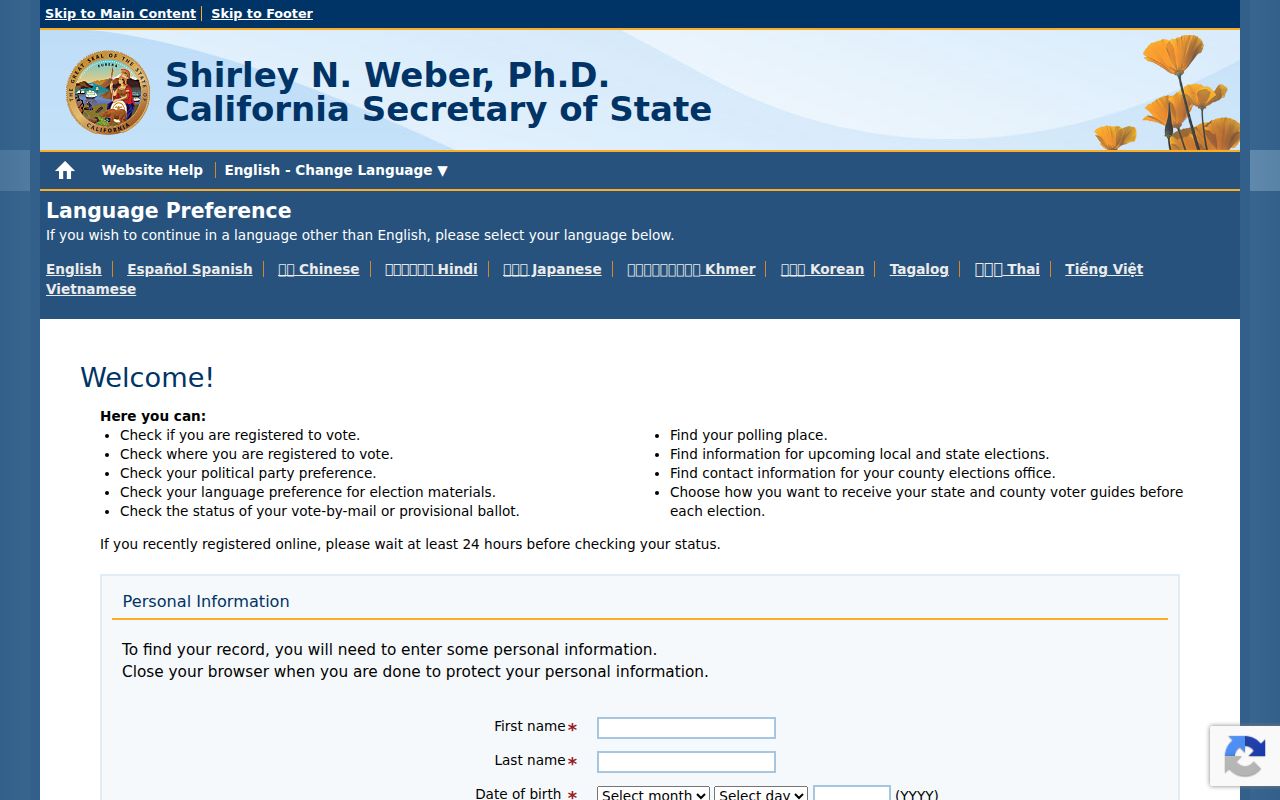
The screenshot matters because the form itself shows why the lookup is an authenticated status check rather than a browseable voter list.
Los Angeles County Verification
Los Angeles County is the election administrator for Beverly Hills. The county verification page states that it is used to determine registration status, and the research captured the page as requiring at least a last name. It may request more voter identifiers before a result appears. That local layer is useful when the statewide status tool points to Los Angeles County or when a Beverly Hills voter needs to confirm county registration before an election deadline.
| County field | Type | Required | How to read it |
|---|---|---|---|
| Last name | Text | Yes | The research excerpt explicitly shows last name as required. |
| Additional voter identifiers | Text or date | Likely required | Exact live fields were not fully exposed in the research result. |
| Submit or search | Button | Yes | Determines the registration status. |
| Language and page controls | Page controls | Optional | lavote.gov provides language and site-search controls. |
The Los Angeles County status verification page is the county-specific check for Beverly Hills voter records.
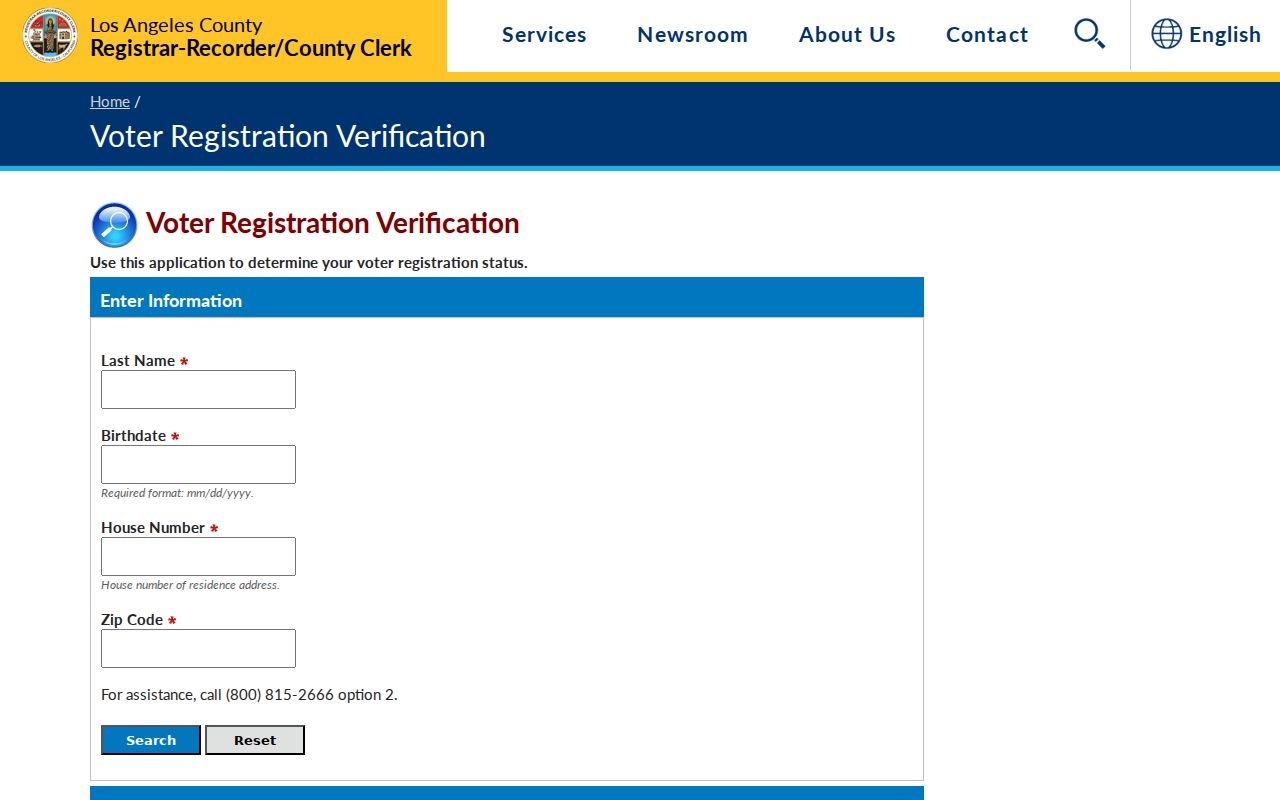
Use the county form as a verification tool, not as a way to search for unrelated people by name.
Beverly Hills Voter Records Are County Records
Beverly Hills is a city inside Los Angeles County, so the local record path does not stop at City Hall. The Los Angeles County Registrar-Recorder/County Clerk administers elections and voter status for the county. California adds the statewide My Voter Status tool, statewide file-request rules, and statutory privacy limits. That split matters when a person has a Beverly Hills mailing clue, a 90210 clue, or an address that may be outside the city limits but still uses a Beverly Hills postal name.
For election records, the safe custodian path is simple. Use the Secretary of State for statewide voter status and voter-file requests. Use LA County RR/CC for county election status and local administration. Use City of Beverly Hills records only for city-held records, such as city public records, permits, and local staff or business-tax material. The voter roll itself is not a city directory.
Note: A Beverly Hills postal address and the City of Beverly Hills are not always the same jurisdiction.
What California Voter Records Show
A California voter record can carry more data than a public status page will display. The research lists name, residence address, mailing address if different, date of birth or birthdate components, party preference, registration status, registration date, county and precinct, districts, voting participation history by election, language preference, contact fields where collected, signature image, DMV or ID verification data, partial SSN verification data, and prior registration data.
That list does not mean each field is open to any reader. The public and confidential split is controlled by Elections Code section 2194 and related sections. Ballot choices are secret. Voter history means whether a person voted in an election, not how the person marked a ballot.
| Full name | Part of the voter record and relevant to status or file matching. |
|---|---|
| Residence address | Collected in the record, but not treated like an open deed-index field. |
| Mailing address | May differ from residence address and may be subject to privacy limits. |
| Party preference | One of the details the status tools can help a voter check. |
| Participation history | Shows whether the voter participated, not ballot choices. |
| Status and registration date | Used to determine whether the record is active or otherwise valid under election rules. |
| Signature and ID data | Sensitive verification material, not a normal public lookup field. |
Elections Code 2194 Privacy Line
California does not treat the Beverly Hills voter roll as a general people-finder file. Elections Code sections 2188 and 2194 restrict access and permitted uses. The research states that home address, telephone number, email address, precinct number, prior registration information, voter ID, driver license, SSN data, and signature are not generally open to the public like a deed index.
Authorized recipients may obtain voter information for election, scholarly, journalistic, political, or governmental purposes as state rules allow. That is a narrower rule than simple curiosity, and the application process asks the requester to explain the purpose in detail. California Code of Regulations sections 19001 through 19009 also govern the review of voter-file requests.
Confidential by law. Confidential voter records under Elections Code sections 2166, 2166.5, 2166.7, 2166.8, and 2166.9 are withheld. Sensitive identifiers and protected addresses are not open public roll data.
Requesting the California Voter File
The California Secretary of State handles voter-file applications. The research source says voter-registration information is available through a request process, but some records are confidential and not provided. The application must describe the requester, the data sought, and the purpose. The research supports no current fee amount, so no dollar figure should be assumed.
The Secretary of State voter-file request page explains the state process for California voter records.
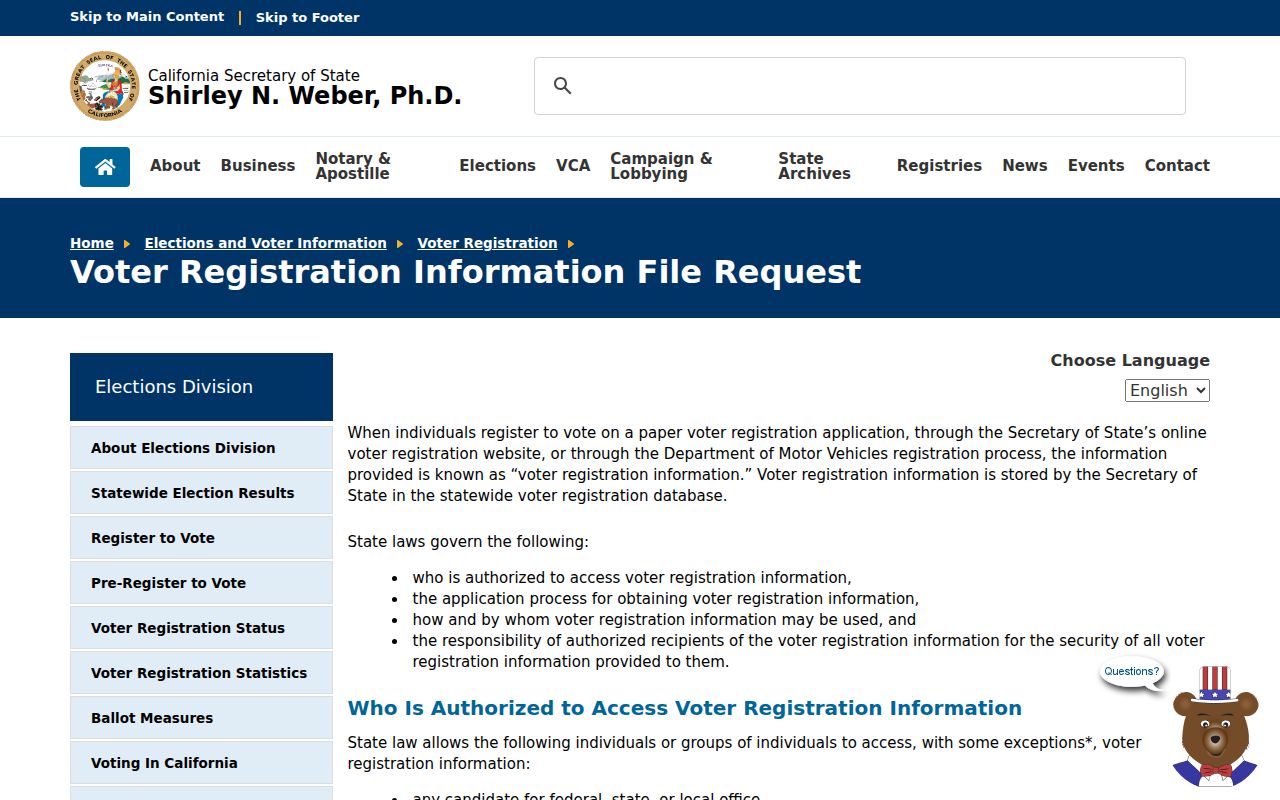
The state request page is separate from the status lookup tools, which is the key distinction for Beverly Hills voters and researchers.
- Identify whether the request is for the full voter file or a specific voter's information, and tie the request to an allowed purpose.
- Complete the state application with applicant information, organization details if any, contact information, requested data, purpose, security certifications, signature, and date.
- Submit the application to the Secretary of State at the Sacramento address listed in the research. The PDF excerpt says emailed and faxed applications are not accepted.
- Wait for review under the Elections Code and California regulations. Confidential records are withheld even when a request is otherwise approved.
Protected Beverly Hills Voters
California's Safe at Home program is run by the Secretary of State and provides a substitute mailing address for qualifying participants. The research connects that protection to voter-record confidentiality. Beverly Hills voters may also be covered by the confidential voter statutes in Elections Code sections 2166 et seq., including provisions for specified protected voters and certain officials or candidates.
These protections affect what a status tool or voter-file request can expose. A person using official records for family history, civic research, or journalistic work should expect gaps where the law shields a participant. The gap is not an error in the database. It is a statutory limit on disclosure.
Beverly Hills Voter Roll Status
Voter rolls change. California list maintenance follows state election law and federal NVRA and HAVA rules. A registration can become inactive after address-confirmation processes, returned mail, or a failure to respond or vote across required cycles. Cancellation is not casual. It is controlled by statutory notice and timing rules.
For Beverly Hills records work, that means an inactive or missing status should be checked against the official tools before any conclusion is drawn. Name changes, a move within Los Angeles County, a move from Beverly Hills to a Beverly Hills Post Office address outside city limits, or a protected voter status can all affect what appears in a lookup.
Historical Beverly Hills Voter Registers
Historical voter-register research is supported only at a broad channel level in the research file. Exact Beverly Hills historical voter-register years were not located in official web sources during the research pass. The supported route is to start with LA County elections archives, the California State Archives, and local libraries, then combine voter clues with Los Angeles County deed records, Beverly Hills permit records, newspapers, obituaries, probate, and Los Angeles-area city or reverse directories.
That approach fits Beverly Hills record history. Los Angeles County records predate the city, Beverly Hills incorporated in 1914, city permit records begin in 1918, and LAPL directories help bridge the space between official county records and old address clues. A historical voter list may be one piece of the trail, but it should not be treated as a complete modern address source.
Beverly Hills Voter Registration Use Limits
California records misuse rules focus on privacy, stalking, harassment, fraud, and improper disclosure. The research flags Penal Code section 646.9 for stalking, Penal Code section 653.2 for electronic harassment and harmful publication contexts, voter-file restrictions and penalties under election law and regulations, and privacy limits for protected records. Use official voter records for lawful civic, scholarly, journalistic, political, governmental, family-history, or personal verification purposes that fit the source.
The strongest myth to avoid is that voter-status tools are public people-search portals. They are not. Beverly Hills voter records can verify status and support approved voter-file requests, but the official tools are designed to protect the voter while confirming election information.
Use the right record path. If the task is general public-records access rather than voter-file access, the broader California Public Records Act framework belongs with the actual custodian for that record type.